Orchestrator Skeleton
December 08, 2025
Translating a Model into Code (Sort of)
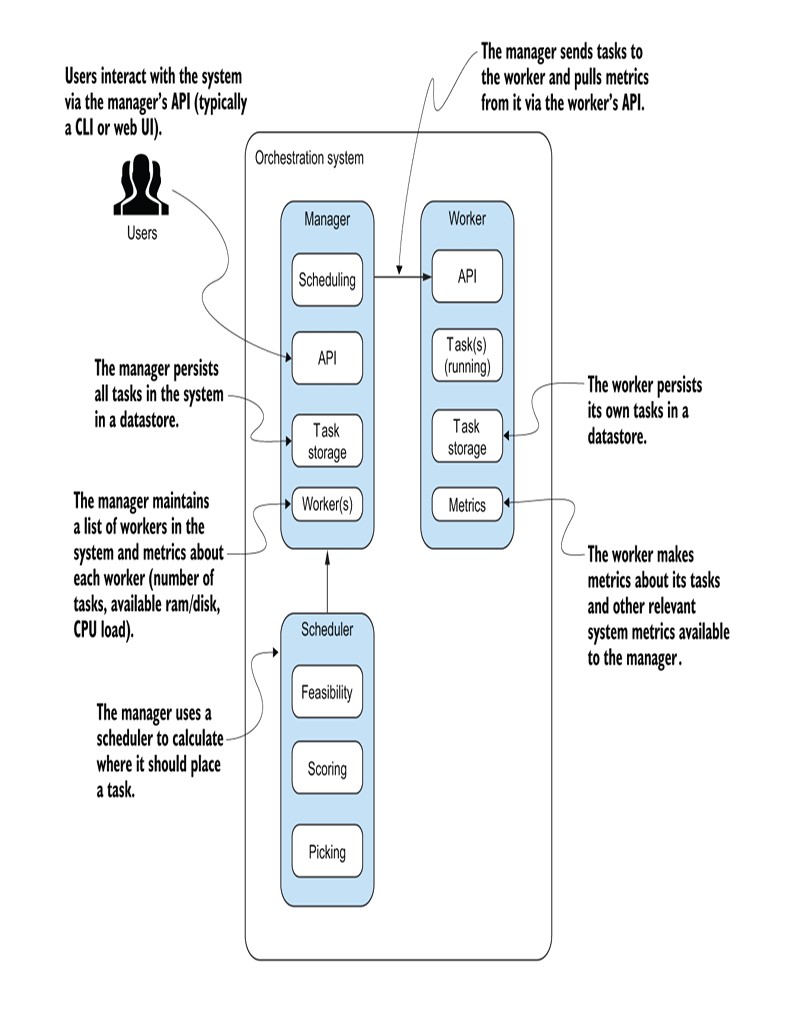
I like to translate a system model into skeleton code early on. This helps me think about the implementation in a more concrete way without getting too deep into details too soon.
At a high level, an orchestrator naturally breaks down into a few obvious components:
- Manager
- Worker
- Scheduler
At the foundation of all of these components, however, is the Task. Everything in the system exists to create, move, run, stop, or observe tasks.
Below is a basic skeleton I found online that inspired this structure:
The Task Skeleton
Task States
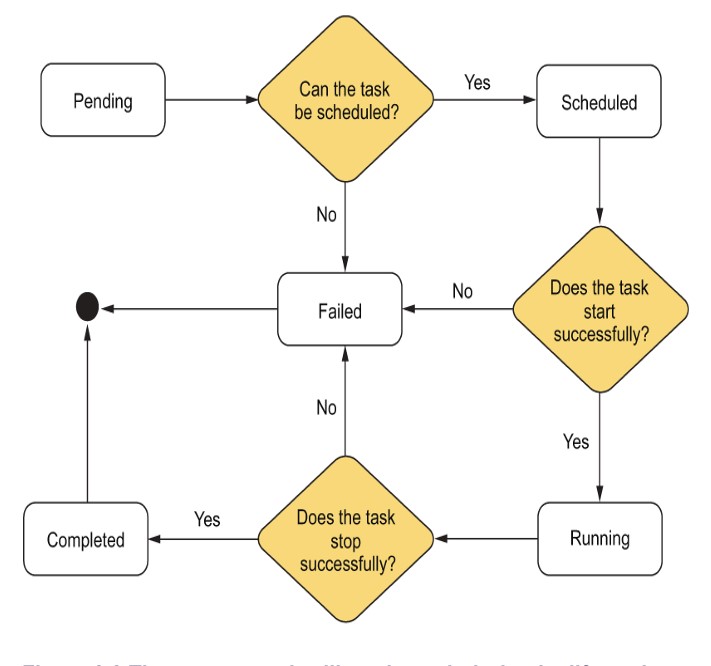
A task in the system moves through a well-defined lifecycle. I model this explicitly using states.
-
Pending The task has been enqueued but not yet scheduled.
-
Scheduled The system has decided which machine should run the task, but the task is still in the process of being sent or started.
-
Running The selected machine has successfully started the task.
-
Completed The task finished successfully or was stopped intentionally by a user.
-
Failed The task crashed or stopped working as expected at any point.
Task Identity
Each task needs a stable identifier. For this, I use UUIDs.
type Task struct {
    ID    uuid.UUID
    Name  string
    State State
}
The State field refers to the task state enum defined earlier.
Task Configuration
As the orchestrator evolves, the task structure needs more metadata:
- Image – Docker image to run
- CPU, Memory, Disk – resource requirements
- ExposedPorts / PortBindings – Docker networking
- RestartPolicy – restart behavior
- StartTime / FinishTime – lifecycle tracking
A more complete task structure looks like this:
type Task struct {
    ID            uuid.UUID
    ContainerID   string
    Name          string
    State         State
    Image         string
    CPU           float64
    Memory        int64
    Disk          int64
    ExposedPorts  nat.PortSet
    PortBindings  map[string]string
    RestartPolicy string
    StartTime     time.Time
    FinishTime    time.Time
}
One important open question here is: How does a user tell the system to stop a task? This becomes clearer once we introduce events.
Project Structure
At this stage, the repository layout looks something like this:
.
├── main.go
├── manager
│   └── manager.go
├── node
│   └── node.go
├── scheduler
│   └── scheduler.go
├── task
│   └── task.go
└── worker
    └── worker.go
Each major concept gets its own package.
TaskEvent
Tasks don’t change state by themselves. State transitions are triggered via events.
A TaskEvent represents a request to move a task from one state to another.
- State – the target state (e.g., Running → Completed)
- Timestamp – when the event was requested
- Task – the task being affected
type TaskEvent struct {
    ID        uuid.UUID
    State     State
    Timestamp time.Time
    Task      Task
}
This is an internal object used by the system to drive task state transitions.
The Worker Skeleton
The worker is the layer that actually runs tasks.
Responsibilities:
- Run tasks as Docker containers
- Accept tasks from the manager
- Provide statistics for scheduling decisions
- Track tasks and their states locally
To do this, the worker maintains:
- Db – an in-memory map of task IDs to tasks
- Queue – tasks sent from the manager
- TaskCount – number of tasks currently running
type Worker struct {
    Name      string
    Queue     queue.Queue
    Db        map[uuid.UUID]*task.Task
    TaskCount int
}
Worker Methods
Some key methods that actually do the work:
-
RunTask Inspects the task state and decides whether to start or stop it.
-
StartTask Starts a task container.
-
StopTask Stops a running task.
-
CollectStats Periodically gathers resource usage and task metrics.
The Manager Skeleton
The manager coordinates the entire system.
Responsibilities:
- Accept user requests to start or stop tasks
- Schedule tasks onto workers
- Track task state and task-to-worker assignments
Key fields:
- pending – a FIFO queue of tasks waiting to be scheduled
- tasks – in-memory database of tasks
- events – in-memory database of task events
- workers – list of worker names in the cluster
To track assignments:
- WorkerTaskMap – maps worker name → task IDs
- TaskWorkerMap – maps task ID → worker name
The manager also needs scheduling logic.
Manager Methods
-
selectWorker Chooses the best worker for a task based on resource requirements.
-
UpdateTasks Refreshes task states and typically triggers
CollectStatson workers. -
SendWork Sends tasks to the selected worker.
The Scheduler Skeleton
Scheduling logic deserves its own abstraction.
Responsibilities:
- Select candidate workers for a task
- Score those workers
- Pick the best one
Initially, a round-robin scheduler is enough:
- Track the last worker that received a task
- Assign the next task to the next worker in the list
To allow flexibility, scheduling is defined via an interface:
type Scheduler interface {
    SelectCandidateNodes()
    Score()
    Pick()
}
This makes it easy to experiment with different scheduling algorithms later.
The Node Skeleton
A worker has a physical aspect: it runs on a machine. That physical machine is modeled as a Node.
A node represents any machine in the cluster.
Key fields:
- Name
- IP – used by the manager to communicate
- Memory / Disk – total available resources
- MemoryAllocated / DiskAllocated – resources currently in use
- TaskCount – number of tasks running on the node
The node exists primarily to expose machine-level stats for scheduling decisions.
The Main Runner
Finally, main.go ties everything together.
At this early stage, it does very basic wiring:
- Create a
Task - Create a
TaskEvent - Print both
- Create a
Worker - Print the worker
- Call worker methods
- Create a
Manager - Call manager methods
- Create a
Node - Print the node
Nothing fancy yet — just enough structure to start reasoning about how all the pieces fit together.
This skeleton doesn’t do much yet, but it gives me a solid mental model and a concrete starting point to iterate on.