Orchestrator, The Worker
December 17, 2025
The Worker: Where the Work Actually Happens
In an orchestration system, the worker is responsible for actually doing the work.
At a very high level, the worker’s job is simple:
- Start tasks
- Stop tasks
In practice, this makes the worker one of the most important components in the system.
In this post, I’ll focus on fleshing out the Worker skeleton we sketched earlier, using the Task and Docker abstractions we already built.
Why Do We Need Workers?
Consider a simple example: a web server that serves static pages.
In many cases, running a single instance of this web server on one machine is enough. But as traffic grows, a single machine can become a bottleneck:
- CPU limits
- Memory pressure
- Network saturation
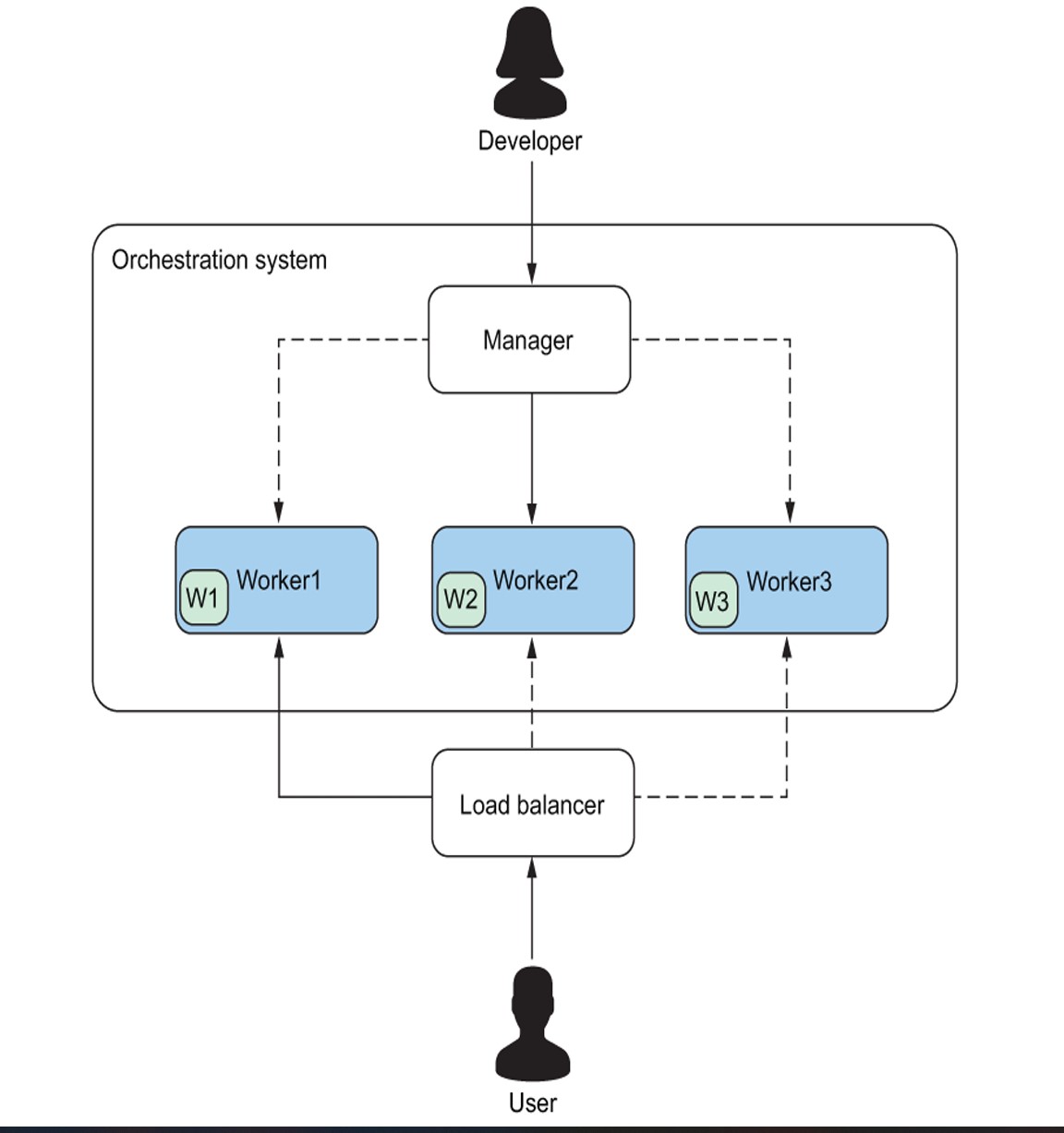
Running multiple instances of the same web server across different machines helps solve these problems. This is where the worker component becomes useful.
The worker allows us to scale applications horizontally by running multiple instances of the same task across machines.
A Small Terminology Note
The term Worker does double duty:
- It represents a physical or virtual machine
- It also represents the worker component of the orchestration system running on that machine
This dual meaning is important to keep in mind as the design evolves.
With multiple workers available, we’re far less likely to run into resource availability issues.
Worker Internals
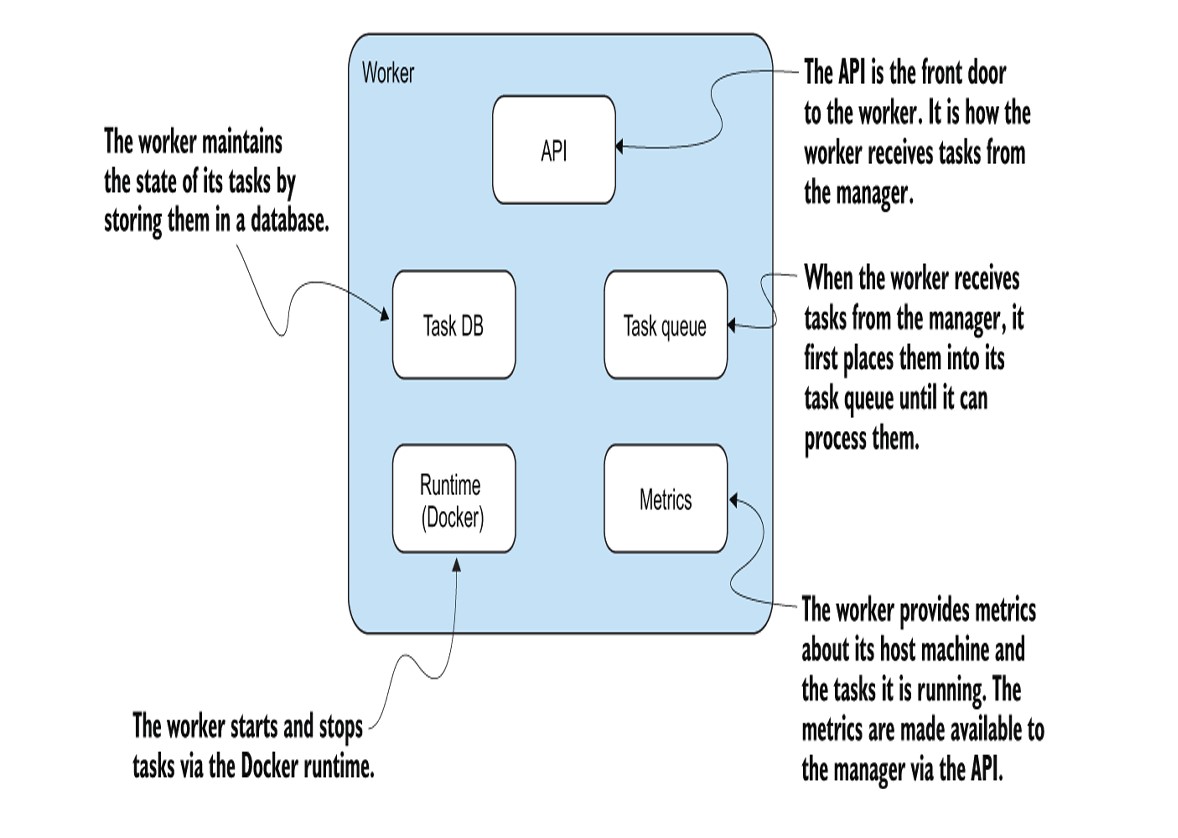
The worker itself is composed of several smaller pieces:
- API – receives work
- Runtime – runs tasks (Docker, in our case)
- Task Queue – incoming desired state changes
- Task Database (DB) – tracks task state
- Metrics – reports stats to the manager
Tasks and Containers
From our task structure, we know that a task performs its work by running as a Docker container.
This gives us a clean, simple relationship:
One task = one container
Two key structs are involved:
-
Task struct Used by the worker to manage state and queues
-
Docker struct Used to start and stop tasks as containers
The worker doesn’t need to know how Docker works internally — it just calls Run and Stop.
The Worker Struct
We previously defined the worker like this:
type Worker struct {
    Name      string
    Queue     queue.Queue
    Db        map[uuid.UUID]*task.Task
    TaskCount int
}
A few important points:
-
Queue This is composition in Go. The worker embeds another type instead of reimplementing queue logic.
-
Db An in-memory map that tracks tasks and their state. Later, this can be replaced with a persistent datastore.
-
TaskCount A simple counter tracking how many tasks the worker is responsible for.
Core Worker Methods
Earlier, we defined three methods but left them incomplete:
RunTaskStartTaskStopTask
Now we’ll fill them in.
Implementing StopTask
The StopTask method has one job: stop a running task.
High-level steps:
- Create a
Dockerobject to talk to the Docker daemon - Call the
Stop()method on the Docker object - Check for errors
- Update the task’s
FinishTime - Save the updated task in the worker’s
Db - Print a useful message and return the result
This closely mirrors running docker stop followed by docker rm.
Implementing StartTask
The StartTask method does the opposite.
Steps:
- Update the task’s
StartTime - Create a
Dockerobject - Call the
Run()method - Check for errors
- Store the container ID in
t.Runtime.ContainerId - Save the updated task in the worker’s
Db - Return the result
The key idea here is encapsulation.
By putting all Docker-related logic inside the Docker object, the worker doesn’t need to know anything about Docker internals.
Implementing AddTask
This method is intentionally simple.
Its only responsibility is to add a task t to the worker’s queue.
The queue represents the desired state of a task.
Managing Tasks with RunTask
The RunTask method is where things get interesting.
Its job is to:
- Look at a task’s current state
- Compare it with the desired state
- Decide whether to start or stop the task
There are two scenarios:
-
First submission The task is not in the worker’s DB yet.
-
Subsequent submission The task already exists, and the new task represents a desired state change.
In our naive implementation:
- The Queue represents desired state
- The Db represents current state
If a task is in the queue but not in the DB, the worker assumes it needs to be started.
Validating State Transitions
Not all state transitions should be allowed.
For example:
- Can a task move from
Runningback toScheduled? - Should a
Failedtask be allowed to transition toScheduled?
Real orchestrators like Borg, Kubernetes, and Nomad solve this using state machines.
We’ll do something simpler: hard-code valid transitions.
var stateTransitionMap = map[State][]State{
    Pending:   []State{Scheduled},
    Scheduled: []State{Scheduled, Running, Failed},
    Running:   []State{Running, Completed, Failed},
    Completed: []State{},
    Failed:    []State{},
}
Each key is the current state, and the value is a list of allowed next states.
Helper Functions
To support this, we need two helpers:
-
Contains Checks whether a state exists in a slice of states
-
ValidStateTransition Wraps
Containsto check if a transition is allowed
These helpers keep the RunTask logic clean and readable.
Implementing RunTask
The RunTask method follows this flow:
- Dequeue a task
- Convert it from
interface{}totask.Task - Retrieve the existing task from the DB
- Validate the state transition
- If desired state is
Scheduled, callStartTask - If desired state is
Completed, callStopTask - Otherwise, return an error
Because the queue stores values as interface{}, we need a type assertion:
t := w.Queue.Dequeue()
taskQueued := t.(task.Task)
This tells Go what concrete type we expect.
Putting It All Together (main.go)
The main.go file ties everything together.
Flow:
- Create a worker
wwith a queue and DB -
Create a task
twith:- State:
Scheduled - Image:
strm/helloworld-http
- State:
- Call
w.AddTask(t) - Call
w.RunTask()
At this point, the container is running.
After sleeping for about 30 seconds:
- Update the task state to
Completed - Call
AddTaskagain with the same task - Call
RunTaskagain
This time, the worker sees the state change and stops the running container.
Final Thoughts
This implementation is intentionally naive, but it demonstrates the core idea:
- The queue represents desired state
- The DB represents current state
- The worker reconciles the two
Even with this simple setup, we already have the foundations of a real orchestration system. From here, we can improve durability, scheduling, and fault tolerance step by step.