Orchestrator, The Worker API
December 19, 2025
Exposing the Worker to the Outside World
Last time, we defined how a worker pulls tasks off its queue and starts or stops them. That was useful, but it only worked locally.
In a real orchestration system, the worker will not be operating in isolation. A manager, running on a completely different machine, needs a way to interact with it.
This means we need a way to expose the worker’s core functionality over the network.
That’s where an API comes in.
API Comes to the Rescue
The worker’s API is intentionally simple. It needs to support only a few basic operations:
- Send a task to the worker (which results in the task being started)
- Get a list of all tasks the worker knows about
- Stop a running task
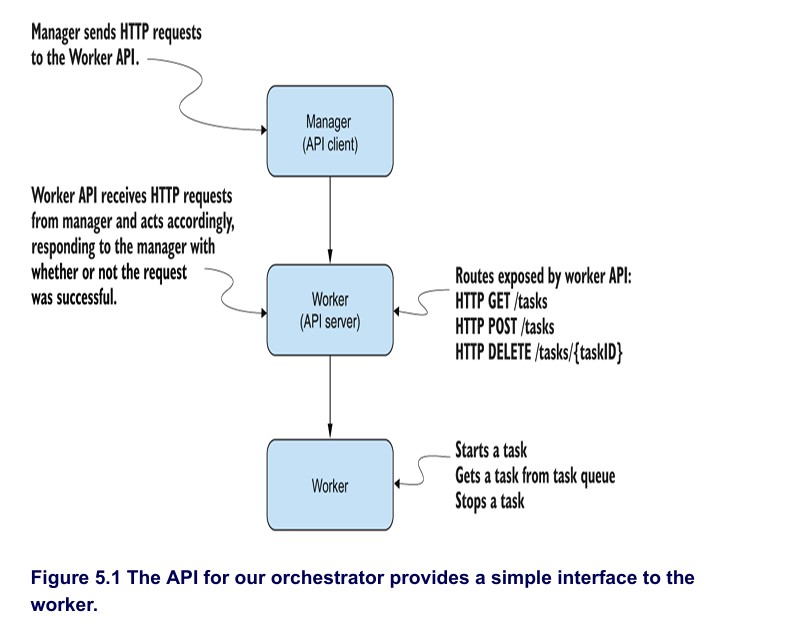
To keep things simple and familiar, the worker exposes a web API. This lets us:
- Communicate over the network
- Use HTTP as the protocol
- Leverage Go’s standard library and existing tooling
API Building Blocks
A basic web API consists of three main components:
-
Handlers Functions that respond to HTTP requests
-
Routes URL patterns that match incoming requests
-
Router A component that maps routes to handlers
We also need parameterized routes, where part of the URL changes per request.
For example:
/tasks/tasks/{taskID}
Here, {taskID} is a variable that represents a specific task.
Worker API Endpoints
The worker exposes the following endpoints:
| Method | Route | Description |
|---|---|---|
| GET | /tasks |
Get a list of all tasks |
| POST | /tasks |
Create (start) a task |
| DELETE | /tasks/{taskID} |
Stop the task identified by taskID |
The API itself is built using:
- Go’s
net/httppackage - The
chirouter - Our own
Workerimplementation
The API Struct
The API is defined in worker/api.go.
Its job is to wrap the worker and expose the worker’s functionality over HTTP.
type Api struct {
    Address string
    Port    int
    Worker  *Worker
    Router  *chi.Mux
}
Field breakdown:
-
Address / Port Where the API server will listen
-
Worker A pointer to the worker instance whose functionality we are exposing
-
Router A
chi.Muxrouter used to define routes and connect them to handlers
Handling Requests
A handler is simply a function that knows how to respond to an HTTP request.
For the worker API, we define three handler methods on the Api struct:
StartTaskHandler(w http.ResponseWriter, r *http.Request)
GetTasksHandler(w http.ResponseWriter, r *http.Request)
StopTaskHandler(w http.ResponseWriter, r *http.Request)
Each handler is responsible for translating HTTP requests into worker actions.
StartTaskHandler
At a high level, StartTaskHandler:
- Reads the request body from
r.Body - Decodes the JSON payload into a
task.TaskEvent - Adds the task event to the worker’s queue
- Logs what happened
- Writes an appropriate HTTP status code to the response
To make this safer, we use:
decoder.DisallowUnknownFields()
This forces the JSON decoder to fail if the request contains fields that don’t exist in task.TaskEvent. It helps catch malformed requests early.
GetTasksHandler
This handler looks simple, but there’s quite a bit happening:
- Set the
Content-Typeheader toapplication/json - Set an HTTP status code
- Create a
json.Encoder - Fetch all tasks using
worker.GetTasks() - Encode the task list as JSON and write it to the response
This endpoint gives the manager visibility into what the worker is currently running.
StopTaskHandler
Stopping a task is done via:
DELETE /tasks/{taskID}
The steps are:
- Extract
taskIDfrom the URL usingchi.URLParam - Convert it from
stringtouuid.UUIDusinguuid.Parse -
Check if the worker knows about this task
- If not, return
404 Not Found
- If not, return
-
If it exists:
- Change the task state to
Completed - Add it to the worker’s queue
- Change the task state to
One subtle but important detail here is copying the task.
The worker’s:
- DB represents the current state
- Queue represents the desired state
Because of this, we dereference the task from the DB and enqueue a copy with the updated state.
Serving the API (Routes)
The Api struct already contains everything we need:
- A
Workerto perform operations - A
Routerto route requests
To actually serve the API, we make two additions to api.go.
initRouter()
This method initializes routing:
- Create a router using
chi.NewRouter() -
Define routes for:
GET /tasksPOST /tasksDELETE /tasks/{taskID}
This connects each route to its corresponding handler.
Start()
The Start() method brings everything to life:
- Call
initRouter() - Start an HTTP server using
http.ListenAndServe
The server listens on the configured address and port and begins accepting requests.
One More Worker Method: GetTasks
For GetTasksHandler to work, the worker needs a helper method:
GetTasks()
This method simply returns all tasks stored in the worker’s DB.
It lives in worker.go and keeps API logic separate from worker internals.
Letting the API Serve Us (main.go)
We continue using main.go as our entry point.
The main() function does the following:
- Create a worker
wwith a queue and DB - Create an API
api, using host and port values from the environment - Start the system
Two important calls make everything work:
Running Tasks Concurrently
go runTasks(&w)
The go keyword starts runTasks in a separate goroutine.
If you’re familiar with threads in other languages, this is roughly the same idea.
Starting the API
api.Start()
This starts the HTTP server and blocks the main thread.
runTasks Function
The runTasks function is intentionally simple:
- It runs in an infinite loop
- Checks the worker’s queue
- Calls
RunTask()when tasks are available - Sleeps for 10 seconds between iterations
The sleep makes logs easier to read while experimenting.
Separation of Concerns
One important design decision here is that:
The API does not start or stop tasks directly.
Instead:
- The API enqueues desired state
- The worker reconciles state and performs actions
This clean separation makes the system easier to reason about and evolve over time.
At this point, we have a worker that can be controlled remotely — a major step toward a real orchestration system.